For decades, CPA firms have worked to improve the efficiency of the month-end close. Cloud accounting, automation, workflow software, and standardized processes have dramatically reduced the time required to produce accurate financial information. Today, many firms complete the close faster and more consistently than ever before.
That progress has been significant.
It has also created an interesting question.
What happens after the books are closed?
For many firms, the answer is surprisingly simple. Financial statements are delivered, dashboards are published, reports are uploaded to a client portal, and the engagement moves on to the next month.
From an accounting perspective, the work is complete.
From an advisory perspective, the work may only be beginning.
Financial Statements Answer What Happened
Business owners rarely ask their CPA for another income statement.
Instead, they ask questions that require judgment and context.
Why has cash flow tightened over the past three months?
Are our margins keeping pace with similar businesses?
Can we afford to hire another salesperson?
What should we focus on before next month's close?
Those conversations begin with financial information, but they don't end there.
They require someone to interpret the numbers, identify what matters most, and help the client determine what actions to take.
That is advisory.
The Traditional Workflow
Most month-end processes follow a familiar sequence.
Financial data is collected and reconciled. The books are closed. A manager reviews the financial statements for accuracy. Reports are generated and delivered to the client.
It's an excellent accounting workflow because it prioritizes accuracy, consistency, and efficiency.
What it doesn't include is a formal process for turning financial information into business decisions.
Many firms assume that if clients receive enough information, they will identify the important trends and ask the right questions.
Some do.
Many don't.
Extending the Workflow
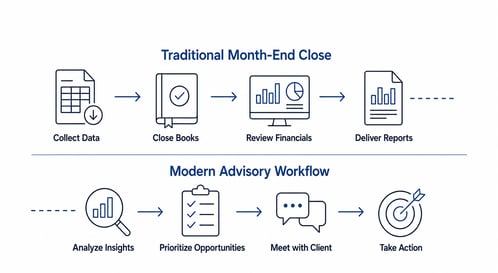 Imagine extending the process by just a few additional steps.
After the books are closed, the firm's technology identifies significant changes in performance, compares results to industry benchmarks, highlights areas that deserve attention, and prepares discussion points for the advisor.
Instead of beginning a meeting by reviewing financial statements, the advisor begins by discussing the three or four issues most likely to influence the client's business over the coming month.
The conversation changes.
The reports become supporting evidence rather than the primary deliverable.
The advisor spends less time explaining numbers and more time helping the client make decisions.
The Opportunity Already Exists
One of the most encouraging aspects of this shift is that firms don't need to create new advisory opportunities.
They already exist.
Every completed month-end close contains information that can strengthen client relationships, uncover new service opportunities, and improve business performance.
The challenge isn't producing more data.
It's building a consistent process that transforms financial information into meaningful conversations.
That missing layer between accounting and advisory is one of the reasons we believe firms will increasingly look for an Advisory Operating System. Not because they need another reporting tool, but because they need a consistent way to move from financial information to client action.
Questions for Your Leadership Team
- Where does your firm's month-end workflow officially end?
- How many clients receive proactive guidance after financial statements are delivered?
- If every advisor followed the same process after the close, what would it include?
- Are you measuring the efficiency of your month-end close, or the impact of the conversations that follow?